
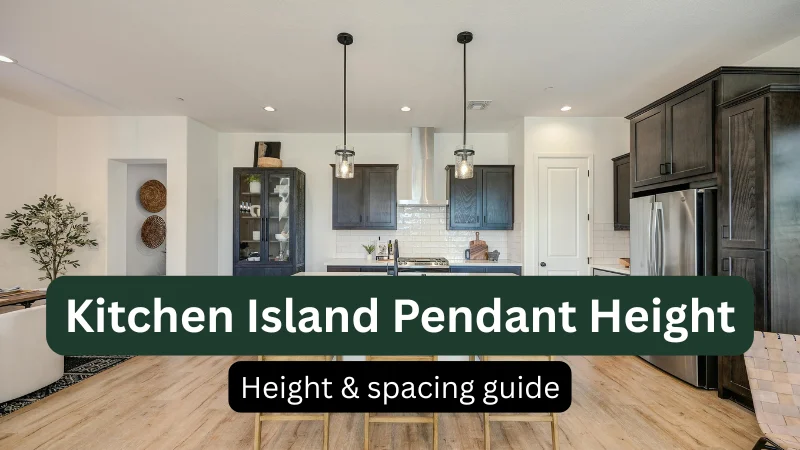
A kitchen island with no pendant lights is just… missing! You can quite easily end up avoiding them altogether if they’re hung too low, and then you end up with lighting that looks like it’s coming from another planet if they’re hung too high.
Getting the height of the pendant lighting over a kitchen island is absolutely the real game. So let’s get the height, the spacing, and the style all sorted before your kitchen becomes a lighting experiment that completely and utterly fails.
What Is the Ideal Pendant Lighting Height for a Kitchen Island?
Imagine your pendant lights are a bit like a guest turning up for dinner too low and they’ll be in everyone’s face; too high and no one will even notice them. Most lighting guides recommend hanging pendant lights around 28–36 inches above the kitchen island countertop, depending on the fixture size, ceiling height, and lighting requirements.
For a standard 8–9 ft ceiling, 30–36 inches is a good place to start. Go toward the lower end for smaller fixtures and the higher end for larger ones.
Very important to be aware of: always measure from the bottom of the pendant to the countertop (not from the ceiling). If you don’t do that, you’re going to be looking at your whole lighting installation going into a math nightmare!
How to Adjust Pendant Height Based on Ceiling Height
Not all ceilings are the same, so why should all your pendant lights be subject to one dull rule?
- Standard ceilings (8–9 ft): keep the pendants 30–36″ above the countertop for the right balance.
- High ceilings (10ft and above): then you’ll need longer rods or adjustable cables. Let your pendants do the talking rather than just vanish into the ceiling!
- Low ceilings (under 8ft), and you’re far better off with a compact pendant or a semi-flush fixture. You just don’t want people banging their heads.
Pro tip: try out various heights with an adjustable cord before you go any further. A bit of fiddling around at this stage can save you a right old mess later on.
How Far Apart Should Pendant Lights Be Over a Kitchen Island?
Getting the height right is all very well, but it’s the spacing that’s the real design issue. You’re aiming for the pendants to look like a perfectly considered trio rather than a set of guests all vying for the best position.
- For medium pendants, 24 to 30 inches (61 to 76 cm) center to center between the fixtures. Here’s how to arrange them:
- Two pendants: place them symmetrically with equal space at either end. No preference either way!
- Three pendants, evenly spaced across the island. It’s all about balance, really; you don’t want a lighting traffic jam.
- Four or more? Go for the smaller ones and plan carefully. Your ceiling isn’t going to be having a pendant party!
Keep the outer fixtures around 6–12″ from the edge of the island. If you’ve got any fairly large pendants, then you’re probably going to need a bit more space.
Pro tip: before you go drilling any holes, just mark the positions with some painter’s tape. Step back and check the layout from a couple of angles and make the requisite amendments. It’s a lot harder to fix a lighting mistake than it is to fix a bad selfie!
How Many Pendant Lights Does Your Kitchen Island Need?
More pendants don’t necessarily equate to more style. Your kitchen island needs good lighting, not a ceiling full of pendants!
Here’s a quick guide to getting the numbers right:
- Small islands (4ft): one statement pendant or two small compact fixtures.
- Medium islands (5–6 feet): two medium pendants will be about all you’ll need.
- Large islands (7-8 ft and longer): three medium pendants or two larger statement fixtures would be appropriate.
Remember fixture size and brightness are just as important as quantity. Three massive pendants over a tiny island? Brilliant, really – your kitchen now has its own lighting department!
Sometimes less is more. Go for the fixtures that complement your island rather than compete with it.
Choosing the Right Pendant Light Size and Style
Your pendants should be in keeping with your kitchen rather than up against it for attention. Get the size wrong, and even the most beautiful fixture can end up completely out of place in the wrong room.
- Small pendants are ideal for small islands and very minimalist kitchens. Two or three of them make a very nice, neat look.
- Medium pendants: the all-rounders! They’re a good mixture of being useful lighting and being decorative.
- Large statement pendants: perfect for a large kitchen where you want the lighting to be the feature (without necessarily taking over the whole worktop).
Style makes a difference too. Glass pendants have that very airy feel, metal shades are a very focused modern look, and ceramic and natural texture shades add a tremendous amount of warmth and character.
Pro tip: match your pendant finishes to the cabinet hardware, the wooden accents, or indeed any of the existing metallic details. A little bit of coordination makes a world of difference, as most well-styled kitchen ideas show. Your kitchen most definitely needs a glow-up rather than a style identity crisis!
Don’t Ignore Bulb Color Temperature and Brightness
Perfect pendant placement but terrible lighting? That’s a kitchen glow-up gone wrong. Your bulb’s color temperature is all about the ambience, and the brightness is all about practicality. Here’s your quick lighting cheat sheet:
| Color Temperature | Lighting Mood | Best For |
|---|---|---|
| 2200K–2700K | Warm, cosy glow | Relaxed dinners and entertaining |
| 2700K–3000K | Soft warm-white | Everyday cooking and kitchen use |
| 4000K | Cool, neutral light | Task-focused kitchen activities |
A Few More Lighting Secrets:
CRI 90 or higher – helps food, ingredients, and kitchen surfaces look more like their natural color. No more mysterious colored tomatoes!
Dimmable LEDs: you can go from ‘cooking’ mode to ‘cosy dinner’ mode without having to change the bulbs.
Pro tip: go for dimmable, high CRI LED bulbs for lighting that’s absolutely practical by day and effortlessly cosy at night. One kitchen, multiple moods!
Common Pendant Lighting Mistakes to Avoid
Even quite attractive pendant lights can lose their sheen if you’ve missed the installation details. Be on the lookout for these common mistakes.
- Hanging the lights too low: this will obviously kill the sightlines and will get in the way of normal kitchen use.
- Uneven spacing: fixtures at odd distances will give the whole island a very unbalanced look.
- Choosing oversized pendants: large fixtures can be quite overpowering on a smaller island and can quite easily make the kitchen feel quite cramped.
- Ignore the purpose of the island completely. A kitchen island which is primarily used for food prep will have quite different lighting needs to one which is primarily an island for dining and seating.
- Forget about glare. Exposed bulbs or bad light placement can obviously be a big source of glare, particularly if you’re sitting at the island.
- Purely relying on pendant lighting: the pendants will give you a bit of focused light and will be decorative, of course, but you simply shouldn’t expect them to light the whole kitchen.
A bit of planning now saves you from rehanging fixtures later.
Why Layered Lighting Makes a Kitchen Look Better
Pendant lights are important, but they work best when used in conjunction with some other form of lighting.
Think of your kitchen lighting as a team rather than a one-trick pony!
Recessed ceiling lights for general illumination, under-cabinet lighting in the food prep areas, and pendant lights that provide both task lighting and a bit of visual interest over the island.
Combining these layers reduces the harshness of the shadows and makes the kitchen a lot more comfortable all day.
Where your fixtures and bulbs are compatible, add dimmers. That lets you change the brightness depending on whether you’re cooking, working, or just having a relaxed dinner.
Final Thoughts: Get Your Kitchen Pendant Lighting Just Right
Finding the ideal pendant lighting height for a kitchen island isn’t really just a matter of measuring. It’s about getting the balance of comfort, practicality, and look right.
Start with the pendants at 30–36″ above the countertop and space your medium-sized fixtures at 24–30″ apart. Then, of course, you’ll need to adjust the layout to suit your ceiling height, island size, and pendant style.
Most importantly, don’t rush the installation. Check the height, check the sightlines, and think about how the lighting’s going to work in normal day-to-day use.
With the right positioning and a little kitchen styling, pendant lights can turn a fairly plain kitchen island into a real feature that looks just as good as it works.
FAQs
How high should pendant lights hang over a kitchen island?
Hang pendant lights about 30–36 inches above the island countertop, measured from the bottom of the pendant to the countertop. This suits a standard 8–9 ft ceiling.
How far apart should pendant lights be over a kitchen island?
Space medium pendants about 24–30 inches apart, center to center, and keep the outer fixtures around 6–12 inches in from each end of the island.
How many pendant lights do I need over a kitchen island?
A small 4 ft island takes one statement pendant or two compact ones, a 5–6 ft island usually needs two medium pendants, and a 7–8 ft or longer island suits three medium pendants or two larger fixtures.
Should pendants hang higher with a high ceiling?
With ceilings of 10 ft or more, keep the pendant bottoms in the same 30–36 inch zone above the countertop and use longer rods or adjustable cables to reach it.
What color temperature is best for kitchen island pendants?
2700K–3000K soft warm white suits everyday cooking, 2200K–2700K gives a cosier glow for dinners, and 4000K cool neutral light suits task-focused work. Choose dimmable LEDs with CRI 90 or higher.